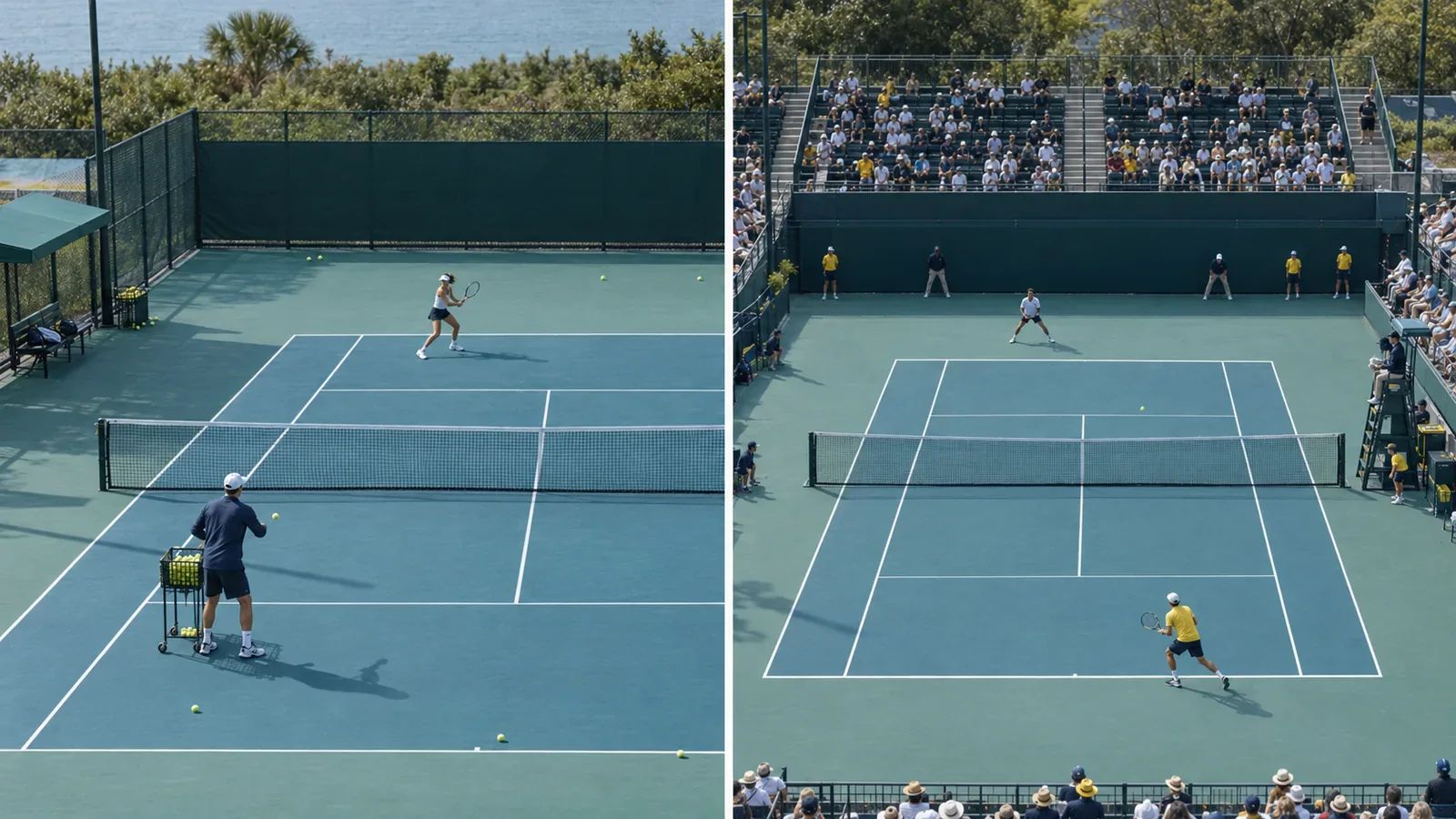
At training the ball can regularly get short, and the strikes are arranged as you plan. Then comes the match and the rival changes the pace, the game is shorter or the strike is unclean. That you practice well doesn’t always immediately translate to the result. Training and the match put other tasks before you.
Repeatability of training and variation of match
Exercises with the coach often have a fixed scheme. You know where the ball comes and where you have to play. Through this you can repeat the movement many times and focus on the techniques. In the match you won’t get the ball in the same conditions: the opponent changes length, direction and pace, and sometimes he plays unconventionally. You need first to read the situation, and only then decide what to do.
Therefore, repeating the hits itself is not enough if you want to feel more confident in the match. It’s also worth training the direction choice and moving around less predictable balls. You can ask your partner to change the pace or play points with a specific task, for example, start the exchange from the service and return.
You need a plan for the game.
Training allows you to work on what you want to improve. The game requires the use of your strong sides and finding the weaker points of the opponent. If during the heating you see that the rival uncertainly plays backhandem, check if deep balls to this page bring a shorter answer. If the second service is weak, you can get closer to the card and reverse pressure. Treat this as an hypothesis to check, not a strange tactic for the whole match.
The result changes the way of thinking.
In the match each point is counted, so it's easier to lose concentration after a mistake or start playing too carefully with a well-known rival. Instead of evaluating yourself after every game, return with attention to the following point: stop, choose a simple plan and play the ball. You don't have to maintain an ideal concentration throughout the match. It helps a short routine between points that allows you to stop and prepare for the next service.
Your self-confidence is not about convincing that you will always win. You can go out on the cards ready to fight for the result, and after the match assess what worked and what is worth exercising. Losing with a difficult opponent can also give a specific clue, for example that you are delayed to the ball on the backhand or you don't know how to respond to the short second service.
Combine the exercise with the game
On the training, pay over repeating techniques to situations in which you have to make a decision. Set a point goal, change the conditions of recording the ball or play a gem with your partner. After the match, save one item that you want to improve, and ask the coach for an exercise that will help you move it to the game. In this way, the training works not only on the hit but also on when and how to use it.