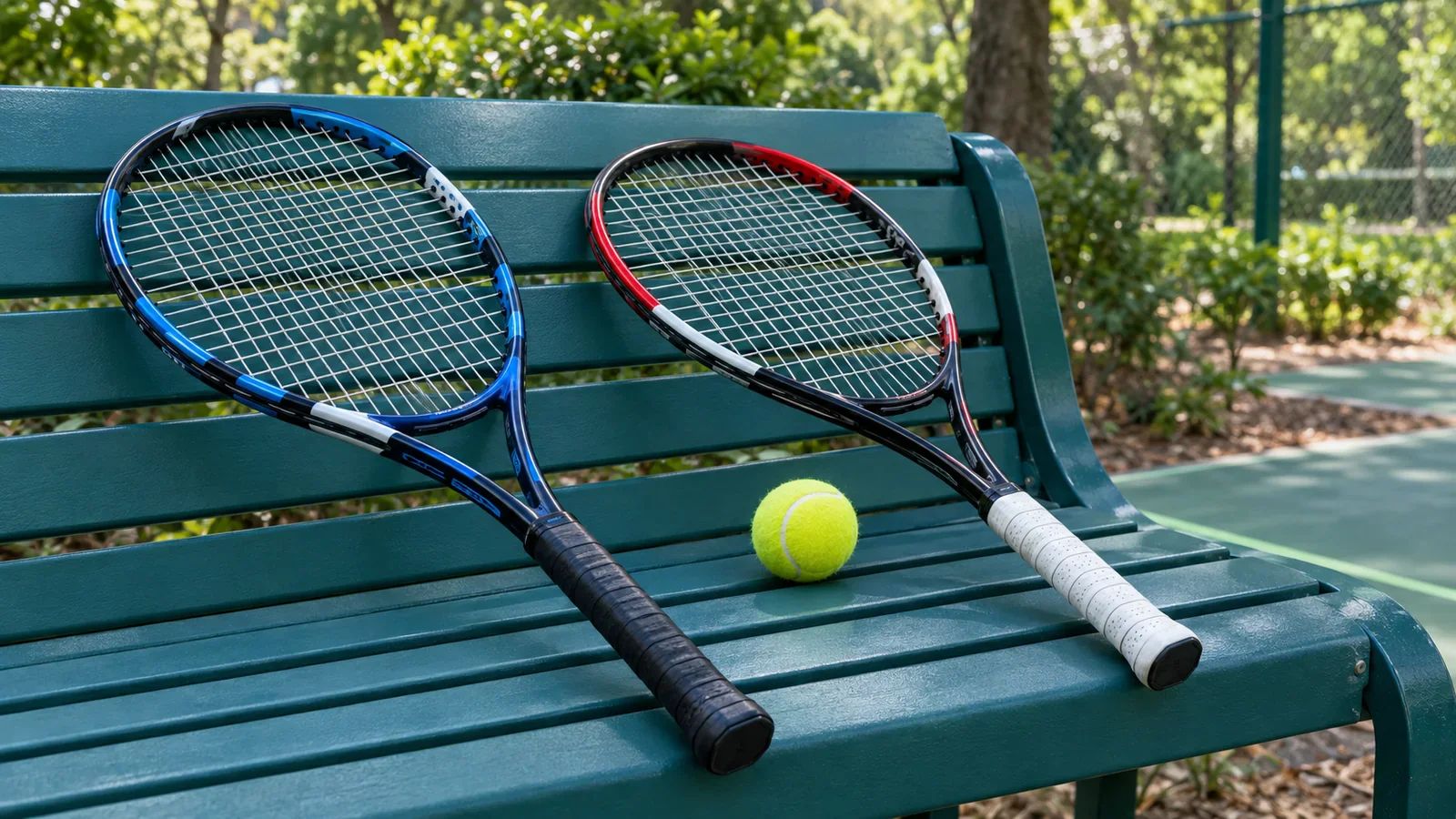
Borrow or demo two adult rackets before you buy. Start with a grip you can hold without squeezing and a frame you can swing comfortably on both sides. A few minutes of practice on court will tell you more than a handful of swings in a shop.
Check the grip size
Hold the handle as you would for a forehand. As a rough starting check, see whether the index finger of your other hand fits into the gap between your fingertips and palm. Try the next size up or down if the fit feels awkward. If you're between sizes, an overgrip can make a smaller handle slightly thicker; reducing a grip that's already too large is harder.
Shops may label grip sizes in different ways. For example, L2 is often 4 1/4 inches and L3 4 3/8 inches. Check the marking on the butt cap or product tag and try the racket in your hand. A demo may already have an overgrip, so ask before ordering the same size online.
Compare weight, balance and head size
Compare rackets in the condition you'll use them. An unstrung weight leaves out the strings, so don't compare it directly with a strung weight. Two frames with the same listed weight can feel different in motion if one carries more weight towards the head. Try both on quick returns and a few serves to see which you can move comfortably.
A larger head gives you more string area to meet the ball. If contact is still inconsistent, compare a larger head with a smaller one and notice which lets you keep your usual swing when you miss the centre. The racket should feel manageable through a whole session, not only on a comfortable feed.
Swingweight describes how much effort it takes to rotate the racket during a swing. A higher swingweight may feel steadier at contact, but can be harder to accelerate. Try the racket on a return where you have less time to prepare, not only on a ball hit straight to you.
Test both rackets on court
Use the same balls and alternate rackets during one session. Hit forehands and backhands, then try serves and returns. Include a few balls hit at your feet or wide to your backhand. Notice whether you can get the racket into position without rushing and repeat your normal swing as the session goes on.
Ask what strings and tension the demos use before attributing every difference to the frame. String type and tension affect feel, too. If you're comparing rackets with different layouts, see our guide to 16x19 and 18x20 string patterns.
Buying a used or pre-strung racket
If you're buying used, inspect the hoop and throat for cracks. Check the bumper at the top and the grommets where the strings pass through the frame. If the strings or grip need replacing, include that cost when comparing prices.
If you're buying new, ask whether the price includes strings and stringing. A pre-strung racket is ready to use; if the frame comes unstrung, check the cost and turnaround time for stringing before your next lesson.